Gypsum plaster is obtained from pure gypsum having high content of calcium sulphate . It is then washe4d treated and calcined at standard specific temperature, pulverized to find mesh sized and hardened using strengthening compounds to give then final products packed in 25 kg bags.
We undertake interior gypsum plastering works and false roof designing and fixing in the Indian states of Kerala, Tamil Nadu & Karnataka. The costs are amazingly CHEAP compared to normal cement, sand plastering with putty finishing. With gypsum plastering our professional team guarantees your walls and ceiling glass like finish with improved features and quality than the conventional cement plastering. Read below to understand.


Gypsum Vermiculite Plaster is manufactured by using Pure Mineral Gypsum , Having high purity of calcium sulphate obtain from mines. It is washed, treated, calcined at std. specific temperature, pulverized to find mesh, sieved & hardening, strengthen compounds & are added to give final product, packed in 25 Kg packing.
Vermiculite is micaceous mineral that exfoliates when heated or subjected certain chemicals reactions . It is basically hydrated magnesium – Aluminum – Iron Silicate.
Bulk density = 0.21Gms/cubic Cms, Absorption of water, 5 times its weight of water & chemically highly inert material totally non – combustible, Thermal insulating material.
| INTIAL SETTING TIME | 6 TO 10 MINITUES |
| FINAL SETTING TIME | 20 TO 25 MINITUES |
| PARTICAL SIZE | 95 % PASSING THROUGH 100 MESH |
| COMPRESSIVE STRENGTH | 55-90 KG / SQ .CM |
| FLEXURAL STRENGTH | 30-35 KG / SQ.CM |
| BULK DENSITY | 0.85 – 0.9 GMS/ CU-CMS |
| MODULUSE OF RATIO (KG PER CM2) | 40 KG / SQ CMS |
| CONSISTENCY (WATER : PLATER RATIO) | (65ML – 70ML) : (100 /GM) |
Area of Application

Gypsum plaster contains no dangerous chlorides. It retains its composition for thousands of years as testified by the construction of the Cheops Pyramids

Gypsum plasters have low conductivity and good thermal properties, ensuring energy and power saving. Tested in accordance to BS 874:1973. Appendix - C, Class "A" in accordance to DIN 4102. The thermal conductivity is 0.32 W/mK.

Gypsum plasters exhibit high tensile and flexural strength. They are less prone to cracking or debonding due to thermal, tensil and shearing movement of the background.

Gypsum plasters will not harbour insects or nourish mould growth or fungi. They pose no health hazards and are therefore frequently specified in hospitals and clinics. They are gentle on the skin and offer a clean, healthy environment.

Gypsum plasters require no water curing and should be permitted to dry out as quickly as possible. A definite advantage considering the weather conditions in the Tropical Country like India

Gypsum is non-combustible (inert), designated class ‘O’ in a accordance to BS 476:4:1970, and contains a high content of crystal water. In the event of fire, will act as a barrier and will protect the blockwork, concrete and steel.

Gypsum (calcium sulphate) as a binder is used in the manufacture of acoustic tiles and plasters, a contributory factor to the absorption of air-borne sounds.

Due to the nature and structure of gypsum, it exhibits excellent bonding properties: hence is applied in a single coat on R.C.C. ceilings, Internal Bare-Brick walls, Hallow Concrete Blocks and Concrete Columns.

The Gypsum blended the gypsum plaster is the perfect rust preventive agent and inhibits corrosion of electric metal fittings, pips, etc. Metal lathings embedded in gypsum plaster will not corrode or rust. Serves durable life-long.
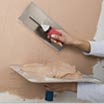
International gypsum plasters are pre-mixed and available in easy to handle bags. Only the addition of water is required. A single coat application suffices in most situations resulting in less wastage of time, labour and material. Semi-skilled masons can be taught how to apply and achieve excellent finishes within a few hours on site.

Gypsum plasters provide a smooth interior finish for ceilings and walls, and is ideal background for good quality paints and wall paper finishes.

Gypsum plasters do not shrink (unlike cement) during the drying out and hardening process.